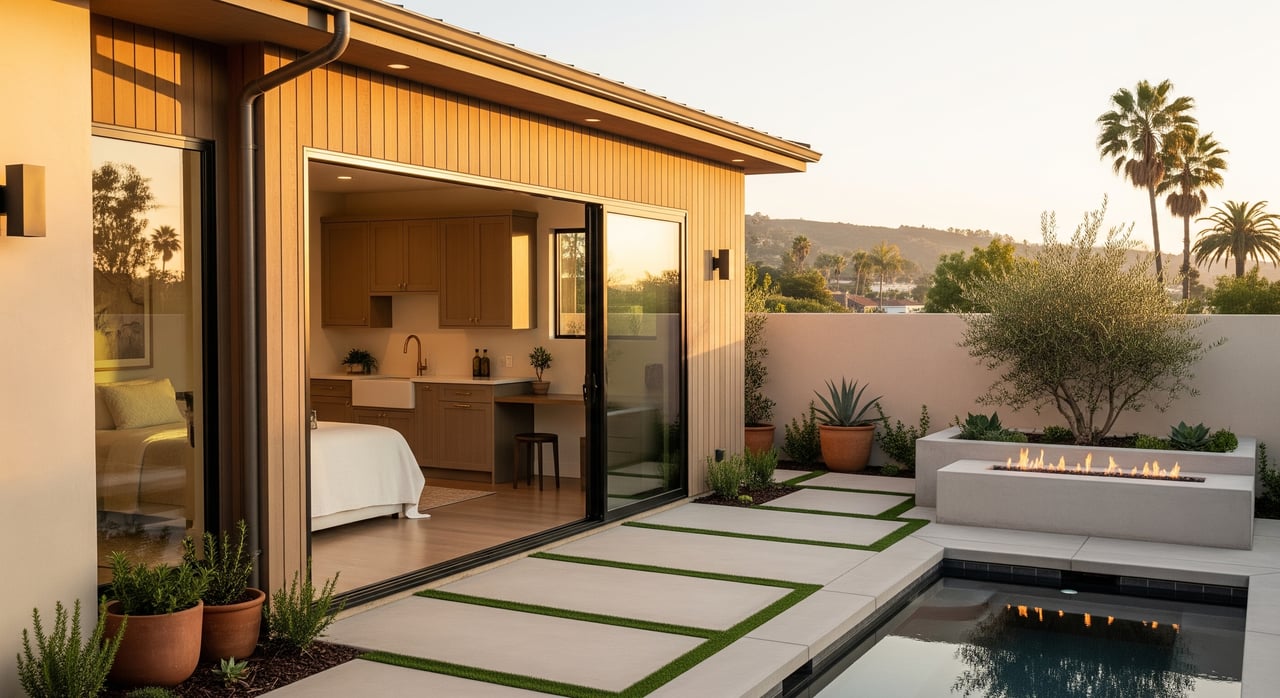
Curious if an ADU on your Laguna Niguel property actually pencils? You are not alone. With high home values and steady rental demand across coastal Orange County, many owners are exploring ADUs to support family or generate income. In this guide, you will get a clear framework to estimate costs, rents, timelines, and returns so you can decide if an ADU fits your goals. Let’s dive in.
Why ADUs pencil in Laguna Niguel
Laguna Niguel sits within the Anaheim–Santa Ana–Irvine metro, where housing costs and rents run well above national averages. That price dynamic, combined with limited for-sale inventory, makes small rentals appealing for both investors and multi-generational households. You will see interest from young professionals, small households, and families seeking a private in-law setup.
Demand is supported by proximity to employment hubs in Irvine, coastal amenities, and transit corridors. In many cases, a well-designed 1-bedroom or studio ADU can rent at levels comparable to similarly sized apartments in the same submarket when it offers privacy and a full kitchen. That is the foundation for a solid, steady ROI.
Costs in Laguna Niguel
Before you model returns, organize your budget into clear buckets. This keeps bids honest and helps you compare detached builds versus conversions.
Hard construction costs
- Typical range for detached new ADUs in Orange County: about $200 to $500 per sq ft depending on site and finishes.
- Garage conversions or JADUs are usually much less, often $30k to $150k depending on scope and upgrades.
- Key drivers: detached vs conversion, foundation and grading, roof and structural needs, kitchen and bath finish level, mechanical/electrical/plumbing complexity, fire separation, and accessibility features.
- Pro tip: Get 2 to 3 local contractor bids and request line-item scope.
Soft costs
- Includes architect or designer, engineering, plan check, building permits, Title 24 energy documentation, and any impact or connection fees that apply.
- Typical range: 10 to 25 percent of hard costs, higher on complex sites.
- Action item: Check the City of Laguna Niguel Planning and Building divisions for current fee schedules and submittal checklists.
Utilities and infrastructure
- Sewer, water, gas, and electrical upgrades plus trenching and HVAC.
- Cost varies from a few thousand dollars to tens of thousands if major trenching or service increases are needed.
- Schedule utility estimates early. Meter timelines can impact your schedule.
Site work and exterior improvements
- Think parking pads, pathways, patios, fencing, privacy screening, or retaining walls. Sloped lots often add cost.
- Consider accessibility or stairs for two-story designs.
Furnishing and rental setup
- Optional furnishing for a small ADU often runs $3k to $15k depending on quality and scope.
- Setup includes locks, security, and tenant screening tools if you plan to rent.
Carrying costs during construction
- If you finance, include interest reserves and lender fees. Also budget for any HOA approvals, incremental insurance, and utilities during the build.
Operating costs once rented
- Include insurance increases, maintenance and reserves (often 5 to 10 percent of gross rent), property management (8 to 10 percent for long-term rentals), vacancy allowance (commonly 5 to 10 percent), owner-paid utilities, and any incremental property tax.
Taxes and reassessment
- Adding an ADU can increase assessed value and property taxes. Rental income is taxable, and depreciation and expenses affect your tax treatment. Speak with a CPA and the Orange County Assessor to understand implications for your property.
Rental revenue and ROI basics
Your rent estimate is the single most important revenue input. Look at small-unit rentals in Laguna Niguel and adjacent communities to benchmark studios and 1-bedrooms. Focus on size, private entrance, full kitchen, in-unit laundry, on-site parking, and finish quality.
- Vacancy: Many long-term ADUs use 5 to 10 percent vacancy in modeling. If you consider short-term rentals, expect higher vacancy and higher management cost, and always verify local rules.
- Management: If you self-manage, you may reduce that line item. Still include a maintenance and turnover reserve.
To model returns, use these straightforward formulas:
- Gross annual rent = monthly rent × 12
- Effective Gross Income (EGI) = Gross annual rent × (1 − vacancy rate)
- Operating expenses = sum of management, maintenance, insurance, taxes, utilities, reserves
- Net Operating Income (NOI) = EGI − operating expenses
- Total project cost = hard costs + soft costs + utilities and site work + furnishings + fees + contingency
- Cap rate = NOI ÷ total project cost
- Cash-on-cash return = annual pre-tax cash flow ÷ total cash invested, where annual pre-tax cash flow = NOI − annual debt service
- Payback period (years) = total cash invested ÷ annual pre-tax cash flow
Example ROI for a 600 sq ft ADU
Below is an illustrative example to show the math. Replace the inputs with your actual bids and rent comps.
Assumptions
- 600 sq ft detached ADU
- Construction at $350 per sq ft → hard cost $210,000
- Soft costs 15 percent → $31,500
- Utilities and site work → $10,000
- Permits and other fees → $10,000
- Contingency 10 percent of hard → $21,000
- Estimated total project cost ≈ $282,500
Revenue and expenses
- Rent → $2,400 per month → $28,800 gross per year
- Vacancy → 6 percent → EGI ≈ $27,072
- Operating expenses → management 8 percent ($2,184) + maintenance and reserves 8 percent of gross ($2,304) + insurance and property tax increment ($2,000) → total ≈ $6,488
- NOI ≈ $20,584
Returns
- Cap rate ≈ 7.3 percent ($20,584 ÷ $282,500)
- If financed with 20 percent down ($56,500) and annual debt service of about $15,000, pre-tax cash flow ≈ $5,584
- Cash-on-cash ≈ 9.9 percent ($5,584 ÷ $56,500)
Interpretation
- In high-value markets like coastal Orange County, cap rates of 5 to 8 percent for small rentals are common benchmarks. Your personal target may differ.
- Small swings in rents, construction costs, or vacancy can move the needle because the rent stream is modest relative to total cost. That is why sensitivity checks matter.
Sensitivity check: two scenarios
Use conservative and optimistic cases to see how the project behaves if costs or rents shift.
Conservative case
- Costs: Hard cost $400 per sq ft → $240,000; soft costs 20 percent of hard → $48,000; utilities and site work → $20,000; permits and fees → $12,000; contingency 12 percent of hard → $28,800. Total ≈ $348,800.
- Rents: $2,200 per month → $26,400 gross per year.
- Vacancy: 8 percent → EGI ≈ $24,288.
- Operating expenses: management 8 percent of gross ($2,112), maintenance and reserves 8 percent of gross ($2,112), insurance and tax increment ($2,500) → total ≈ $6,724.
- NOI: ≈ $17,564 → Cap rate ≈ 5.0 percent.
What it means: The project still works as a long-term hold, but the return is tighter. Debt terms will drive cash-on-cash. If your annual debt service is near $16,000 to $18,000, cash flow ranges from slightly positive to slightly negative.
Optimistic case
- Costs: Hard cost $300 per sq ft → $180,000; soft costs 12 percent of hard → $21,600; utilities and site work → $8,000; permits and fees → $8,000; contingency 8 percent of hard → $14,400. Total ≈ $232,000.
- Rents: $2,650 per month → $31,800 gross per year.
- Vacancy: 5 percent → EGI ≈ $30,210.
- Operating expenses: management 8 percent of gross ($2,544), maintenance and reserves 8 percent of gross ($2,544), insurance and tax increment ($2,000) → total ≈ $7,088.
- NOI: ≈ $23,122 → Cap rate ≈ 10.0 percent.
What it means: With tighter build costs and higher rent, returns look compelling even after typical financing.
Design choices that lift ROI
The right design can boost rent, reduce friction, and control costs.
Features renters pay for
- Private entry and clear separation from the main home strengthen privacy and appeal.
- A full kitchen and full bath help command apartment-level rents for a small unit.
- Separate utilities or submeters shift usage costs to tenants and reduce owner expenses.
- Storage and efficient closets make compact spaces feel larger and more livable.
- On-site parking allocation and good sound separation enhance comfort and value.
Cost-smart ways to build
- Garage conversions or internal ADUs often cost less than detached builds for the same interior area, if the structure and code allow.
- Modular or prefab ADUs can shorten schedules and sometimes lower costs. Vet manufacturers and verify site prep.
- Use efficient floor plans and durable, mid-range finishes. Quality appliances and hard-wearing surfaces attract tenants without luxury markups.
Accessibility and multi-gen appeal
- Single-story plans, step-free entries, and universal design features expand your tenant pool and can help aging family members live independently.
Permitting and timing in Laguna Niguel
California’s ADU laws streamline approvals for compliant projects, but local implementation and fees are handled by each city. Laguna Niguel applies state rules through its municipal code and permit processes, with objective standards for setbacks, height, and life-safety codes.
Typical timeline
- Preliminary feasibility: 2 to 4 weeks to confirm zoning, setbacks, and utilities.
- Design and plans: 4 to 12+ weeks for drawings, engineering, and Title 24 documentation.
- Plan check and permits: 2 to 12+ weeks depending on workload and whether the project is ministerial.
- Construction: 2 to 9+ months. Conversions are usually faster than detached builds with significant site work.
- Overall: About 4 months for a simple conversion to 12 to 18 months for a detached unit on a constrained lot.
Parking, HOAs, and short-term rentals
- State law limits ADU parking requirements in many scenarios and provides exemptions near transit or for smaller units. Always confirm your specific lot conditions.
- HOAs cannot necessarily prohibit ADUs but may enforce objective aesthetic standards. Review your CC&Rs and approval steps early.
- If you plan short-term rentals, verify Laguna Niguel’s rules and any HOA restrictions. Expect potential transient occupancy taxes, added insurance, and higher management costs if allowed.
Financing options to consider
Owners commonly use cash, a HELOC or home equity loan, a construction loan, or other renovation products. Lenders vary in how they underwrite ADUs and how appraisers value them. Some products may account for the ADU’s contribution to value after completion. A local mortgage professional familiar with ADUs can compare terms and closing timelines.
Simple next steps
- Check local rents for studios and 1-bedrooms in Laguna Niguel and nearby submarkets to anchor your estimate.
- Contact the city to confirm zoning, setbacks, height limits, and general feasibility for your lot.
- Get two to three bids from ADU-experienced designers and contractors, and explore whether a garage conversion could meet your goals at lower cost.
- Build a simple spreadsheet with conservative and optimistic cases using the formulas above. Include vacancy, maintenance, and realistic financing terms.
- Confirm tax and reassessment implications with a CPA and connect with a lender who understands ADU financing.
- If you have an HOA, request written guidance on approvals and architectural standards before you finalize plans.
When you approach an ADU like a business plan, the numbers in Laguna Niguel can make sense. Strong local rents, thoughtful design, and clean execution are the keys to a steady, low-drama income stream or a flexible living solution for family. If you want a second set of eyes on your assumptions or a referral to trusted local pros, reach out to our team at Domaine Luxury Properties for concierge guidance tailored to your property.
FAQs
What does an ADU cost in Laguna Niguel?
- Detached builds often land around $200 to $500 per sq ft for hard costs, while garage conversions or JADUs can run about $30k to $150k depending on scope, site, and finish level.
How long does an ADU take from idea to rent?
- Simple conversions can move from feasibility to lease in about 4 months, while detached builds on complex sites can take 12 to 18 months including design, plan check, and construction.
Can you use an ADU for short-term rentals in Laguna Niguel?
- Possibly, but rules vary by city and HOA. Verify Laguna Niguel’s current policies and confirm taxes, insurance, and management costs before you assume short-term income.
How will an ADU affect your property taxes in Orange County?
- Adding an ADU typically increases assessed value and taxes. The specifics depend on the assessor’s treatment and your project scope, so consult the Orange County Assessor and a CPA.
Is an ADU a good investment in Laguna Niguel right now?
- It can be. High local rents and steady demand support the case, but feasibility depends on your actual build costs, achievable rents, and financing. Model conservative and optimistic cases before you decide.
What ADU features increase rent in coastal Orange County?
- Private entry, a full kitchen and bath, separate utilities or submeters, good sound separation, storage, and on-site parking typically improve appeal and help support higher rents.